

Introduction
In the modern business landscape, electronic equipment is the backbone of operational efficiency and innovation. From the factory floor to the executive office, companies leverage technology to streamline processes, reduce costs, and gain a competitive edge. This report explores the various facets of electronic equipment in the corporate world, outlining its benefits, the types of companies that rely on it, market leaders, and future trends.
Benefits of Electronic Equipment For Companies
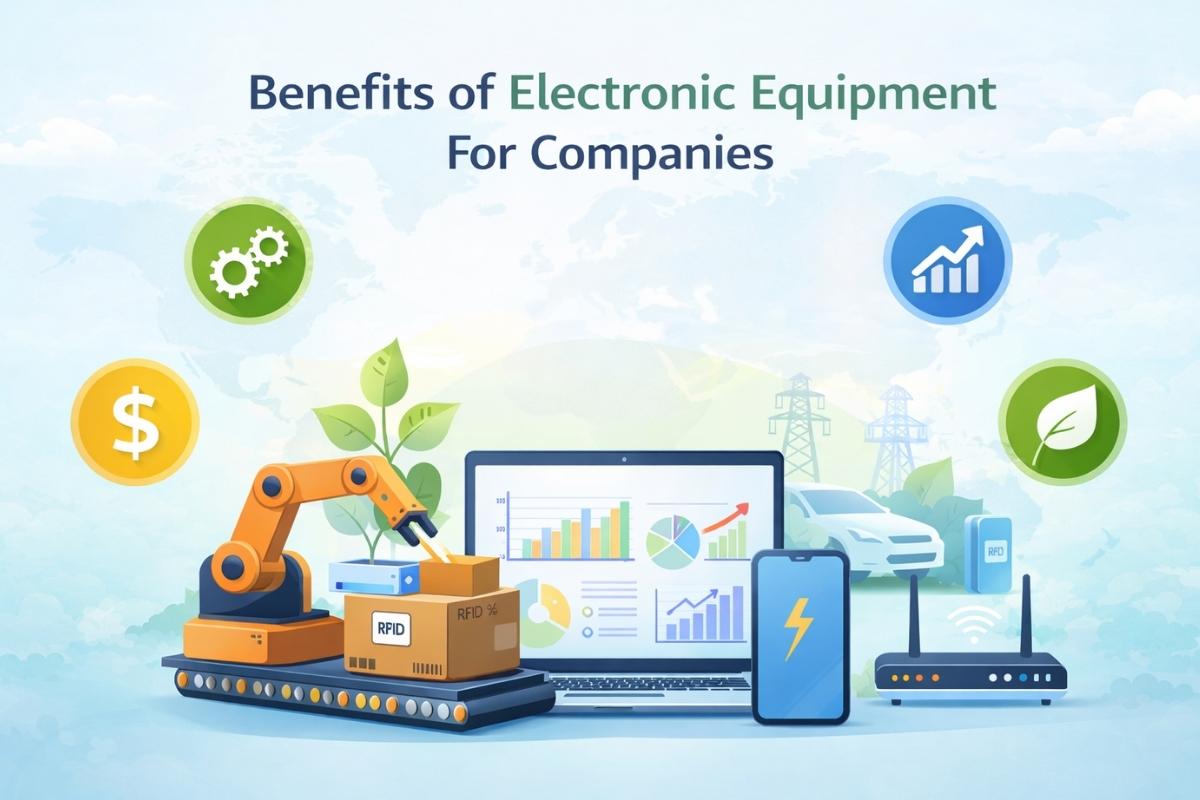
Integrating advanced electronic systems and devices offers tangible advantages. Below is a summary of key benefits supported by industry trends
| Benefit | Description | Example / Impact |
|---|---|---|
| Operational Efficiency | Automation of manual tasks and real-time data access speeds up workflows. | RFID for inventory management saves labor costs; rugged devices reduce downtime in logistics . |
| Cost Reduction | Smart systems optimize resource use, and durable tech lowers replacement frequency. | Smart thermostats and lighting cut energy bills; rugged devices offer a lower total cost of ownership . |
| Enhanced Data & Insights | IoT devices generate data that reveals inefficiencies and opportunities. | Real-time diagnostics in manufacturing enable predictive maintenance, preventing costly breakdowns . |
| Improved Customer Experience | Connectivity allows for real-time updates and personalized service. | Tracking features for on-site services (similar to Uber) increase customer comfort and confidence . |
| Sustainability | Longer-lasting equipment and energy-efficient operations reduce environmental impact. | Modular rugged devices reduce e-waste; trade-in programs promote greener appliances . |
Different Companies and Their Electronic Equipment
The type of electronic equipment a company uses depends largely on its industry. Here is a breakdown of how different sectors utilize technology.
| Industry | Company Type | Common Electronic Equipment Used |
|---|---|---|
| Retail | Bike Shops, General Merchandise | RFID tags for inventory, connected point-of-sale (POS) systems, digital signage . |
| Manufacturing | Industrial Factories | Industrial robots, process controllers, rugged tablets for technicians, IoT sensors . |
| Logistics & Transportation | Shipping Companies, Delivery Fleets | GPS trackers, rugged handheld scanners, real-time tracking platforms, RF communication systems . |
| Office Environments | Corporate Headquarters | Smart thermostats (e.g., Nest), automated lighting, VoIP phones, security systems . |
| Healthcare | Hospitals, Field Clinics | MRI/CT scanners, patient bedside monitors, heart pacemakers, rugged mobile devices for data logging . |
| Field Services | On-site Auto Repair, Utilities | Mobile devices with 5G connectivity, diagnostic tools, drones for site inspection . |
Electronic Equipment Stocks (Market Insights)

The electronics sector is a significant area of focus for investors. The Allianz Sector Risk Report (July 2025) notes that the industry is currently caught between “AI hype and geopolitical pitfalls,” highlighting both its growth potential and vulnerability to supply chain issues .
Key market drivers and risks include:
-
AI and Data Centers: Massive investment in data centers is a primary demand driver for advanced semiconductors and power management equipment .
-
Automation (Industry 4.0): The push for productivity gains is increasing demand for automation and control systems .
-
Geopolitical Tensions: The “semiconductor war” between the US and China creates supply chain uncertainty, as over 75% of wafer production is concentrated in Asia .
-
Market Performance: In India, the Electric/Electronics sector showed a 27.5% one-year return and a 183.69% three-year return as of early 2026, demonstrating strong long-term growth despite short-term volatility .
Top 10 Electrical Equipment Manufacturing Companies (Global)
Based on market capitalization as an indicator of size and value, here are some of the world’s leading electrical equipment manufacturing companies as of December 2025 .
| Rank | Company | Ticker | Market Cap (approx.) | Country |
|---|---|---|---|---|
| 1 | Schneider Electric | SBGSY | $156.27 B | France |
| 2 | Eaton Corporation | ETN | $124.54 B | Ireland |
| 3 | ABB | ABBNY | $106.75 B | Switzerland |
| 4 | Emerson Electric | EMR | $75.85 B | USA |
| 5 | Vertiv Holdings | VRT | $63.56 B | USA |
| 6 | AMETEK | AME | $48.03 B | USA |
| 7 | Rockwell Automation | ROK | $44.75 B | USA |
| 8 | Legrand | LGRDY | $38.69 B | France |
| 9 | WEG | WEGZY | $36.11 B | Brazil |
| 10 | Fuji Electric | FELTY | $10.10 B | Japan |
Other Uses of Electrical Equipment
Beyond traditional corporate IT and manufacturing, electrical components are fundamental to a vast array of specialized applications. This demonstrates the pervasive nature of electronics in modern life .
| Application Area | Specific Uses |
|---|---|
| Extreme Environments | Submarine cable repeaters (deep ocean), microwave transceivers (geostationary orbit) . |
| Medical & Scientific | Inside the human body (pacemakers), nuclear instrumentation, particle accelerators . |
| Aerospace & Defense | Onboard computers for satellites and launch vehicles, RF-over-fiber for defense, soldier helmet visors . |
| Infrastructure | Grid network management, waste management systems, EV charging stations . |
Sales of Electronic Equipment For Companies (Yearly Trends)
Sales data often reflects broader economic trends and policy impacts. A significant example comes from China, a major global market for electronics.
In 2025, China reported record highs in sales driven by a consumer goods trade-in program :
-
Home Appliances: Retail sales reached nearly 1.17 trillion yuan (~$167 billion), an 11% increase.
-
Communication Equipment: Sales approached 1.01 trillion yuan (~$144 billion), a significant 20.9% increase.
-
Market Driver: The trade-in program facilitated the purchase of over 129 million home appliances and 91 million digital products, with a strong shift toward AI-equipped (83% of sales) and energy-efficient (90% of sales) models.
This data highlights how government policy and technological advancement (specifically AI) are converging to drive massive sales volumes, a trend likely mirrored in B2B sectors as companies upgrade their equipment.
Conclusion
Electronic equipment is no longer just a support function—it is a strategic asset that drives productivity, innovation, and long-term competitiveness. Across industries such as retail, manufacturing, logistics, healthcare, and corporate environments, companies rely on advanced technologies like IoT, automation systems, AI-driven analytics, and smart infrastructure to optimize operations and enhance customer experiences.
Despite geopolitical risks and supply chain challenges, strong market returns and rising global demand—especially in AI, automation (Industry 4.0), and energy-efficient systems—indicate sustained growth potential. Leading global manufacturers continue to shape the future through innovation in power management, automation, and digital transformation technologies.
In short, electronic equipment remains fundamental to business resilience, sustainability, and future growth.
FAQs
- Why is electronic equipment important for companies?
It improves operational efficiency, reduces costs, enhances data-driven decision-making, and strengthens customer experience.
- Which industries rely most on electronic equipment?
Manufacturing, logistics, healthcare, retail, office environments, and field services are among the most dependent sectors.
- What are the biggest growth drivers in the electronics sector?
AI adoption, data center expansion, automation (Industry 4.0), smart infrastructure, and energy-efficient systems.
- What risks affect the electronics market?
Geopolitical tensions, semiconductor supply chain disruptions, and global trade restrictions.
- Are electronic equipment stocks a good long-term investment?
Historically, the sector has shown strong long-term growth, especially in emerging markets like India, though short-term volatility exists.
- How does electronic equipment support sustainability?
Energy-efficient systems, modular designs, longer product lifecycles, and smart resource management reduce environmental impact.
