


How AI Is Transforming Claims Management: Workflow-Level Impact, KPIs, and Real-World Risks
AI is transforming claims management at the workflow level—from FNOL to settlement—by automating structured tasks, augmenting judgment, and easy core KPIs like cycle time, leakage, and fraud detection. The real shift is not faster claims, but intelligent decision support fixed into each stage of the claim’s growth.
Claims management has always been the operational heart of insurance. It is also where friction lives.
Customers file claims during stressful moments. Adjusters juggle documentation, compliance, negotiation, and time pressure. Executives monitor loss ratios and expense lines. Everyone wants speed. No one wants to make mistakes.
So what is AI changing?
In short: AI is compressing decision time while increasing consistency — but only when applied at specific workflow bottlenecks.
Not everywhere. Not magically. And not without trade-offs.
What Does AI Actually Change in Claims Management?
At a high level: speed, consistency, and prioritization.
At a practical level:
- Claims are categorized faster.
- Low-complexity cases move with fewer touchpoints.
- High-risk cases surface earlier.
AI does two things simultaneously:
- Automates structured tasks (data extraction, classification, routing).
- Augments judgment-heavy decisions (fraud suspicion, reserve estimation, settlement guidance).
It rarely eliminates human roles. It changes how those roles spend time.
That distinction matters.
Before AI: The Traditional Claims Workflow
Strip away the marketing language and most claims workflows historically looked like this:
- FNOL — customer reports incident.
- Manual intake — adjuster collects missing details.
- Triage — someone decides complexity level.
- Coverage review — policy documents are scanned.
- Inspection — physical or virtual.
- Fraud review — red flags reviewed late in process.
- Negotiation and settlement.
- Subrogation (sometimes, often delayed).
This model works. But it’s slow. And inconsistent.
Pain points accumulate:
| Stage | Common Friction |
| FNOL | Incomplete or inconsistent data |
| Triage | Subjective categorization |
| Coverage | Manual policy interpretation |
| Inspection | Scheduling delays |
| Fraud | Detected reactively |
| Settlement | Negotiation variability |
Consultancies like McKinsey and Deloitte have long identified claims as one of the most cost-intensive functions in insurance. And much of that cost comes from repetition and rework.
AI targets repetition first.
Where AI Intervenes (Stage by Stage)
The transformation is not abstract. It is surgical.
1. FNOL: Smarter Intake
AI-powered intake systems:
- Capture structured data automatically.
- Extract policy numbers from uploaded documents.
- Flag missing fields in real time.
- Transcribe and summarize calls.
Instead of multiple follow-ups, information is validated at entry.
That alone reduces downstream friction.
But it also introduces risk: if the model misinterprets data, the error travels faster. Early validation checks are critical.
2. Intelligent Triage
This is where meaningful impact begins.
Predictive models analyze historical claims patterns and assign:
- Severity score.
- Fraud probability.
- Complexity classification.
Simple claims move forward quickly. Complex ones escalate early.
This shift reduces backlog — but only when models are trained on clean historical data. Poor data produces confident mistakes.
Deloitte’s industry research often highlights predictive triage as one of the highest-ROI entry points for AI adoption in claims.
3. Coverage Validation Through NLP
Natural language processing tools parse policy wording and match it against claim details.
Instead of manual page-by-page review, AI surfaces relevant clauses and exclusions.
However, coverage interpretation is not purely mechanical. Edge cases still require experienced adjusters.
AI accelerates review. It does not replace legal reasoning.
4. Computer Vision in Damage Assessment
In auto and property lines, image analysis models estimate:
- Visible damage.
- Repair cost ranges.
- Likely part replacements.
For minor auto claims, this reduces physical inspections.
But image-based assessment struggles in:
- Poor lighting.
- Complex structural damage.
- Intentional obfuscation.
Computer vision performs best in high-frequency, standardized damage types. Less so in atypical claims.
5. Fraud Detection: Pattern Recognition at Scale
Fraud detection is one of AI’s strongest use cases.
Models identify anomalies across:
- Claim timing.
- Behavioral signals.
- Network connections between entities.
Organizations like the Coalition Against Insurance Fraud emphasize that fraud is systemic and adaptive. AI helps insurers move from reactive detection to pattern-based prevention.
Yet aggressive fraud scoring creates reputational risk if false positives are not carefully reviewed.
Human escalation pathways remain essential.
6. Settlement Optimization
Advanced models analyze historical outcomes and recommend:
- Reserve levels.
- Likely settlement range.
- Litigation probability.
This improves consistency in reserve setting.
It also raises governance questions. When automated recommendations influence payout decisions, explainability becomes critical — especially in jurisdictions with stricter AI transparency regulations (e.g., parts of the EU).
Automation vs Augmentation: A Practical Framework
AI in claims fits into two buckets.
Automation (Low Discretion Tasks)
- Data extraction.
- Duplicate detection.
- Basic eligibility checks.
- Workflow routing.
Augmentation (High Discretion Decisions)
- Fraud suspicion scoring.
- Complex settlement guidance.
- Litigation forecasting.
- Severity prioritization.
The second category demands human-in-the-loop oversight.
The World Economic Forum and multiple regulatory bodies emphasize that financial decision-making AI must remain explainable and reviewable.
In practice, mature insurers combine automation and augmentation rather than pushing toward full autonomy.
What KPIs Actually Move?
Not every metric improves automatically.
The ones most commonly affected:
- Cycle Time – Reduced via automated triage and intake.
- Loss Adjustment Expense (LAE) – Lower inspection costs for simple claims.
- Claims Leakage – Improved consistency reduces overpayments.
- Fraud Detection Rate – Earlier anomaly detection.
- Customer Satisfaction – Faster updates, clearer communication.
But impact varies.
An insurer with fragmented data systems may see limited gains. Another with centralized data and strong governance may see dramatic workflow compression.
The algorithm is rarely the bottleneck. Infrastructure is.
The Governance Layer (Often Ignored)
AI transformation without governance creates new risk categories.
| Risk | What It Looks Like | Why It Matters |
| Data Bias | Uneven outcomes across segments | Regulatory scrutiny |
| Model Drift | Gradual accuracy decline | Hidden leakage |
| Explainability Gaps | “Black box” decisions | Legal exposure |
| Cybersecurity | Data breaches | Trust erosion |
| Over-Automation | Customer dissatisfaction | Brand damage |
Regulators in the US (including NAIC guidance) and the EU increasingly examine how automated systems influence financial outcomes.
Claims decisions directly affect individuals’ financial recovery. That raises the stakes.
The AI Maturity Curve in Claims
Most insurers are not operating fully autonomous claims systems.
Adoption tends to progress through stages:
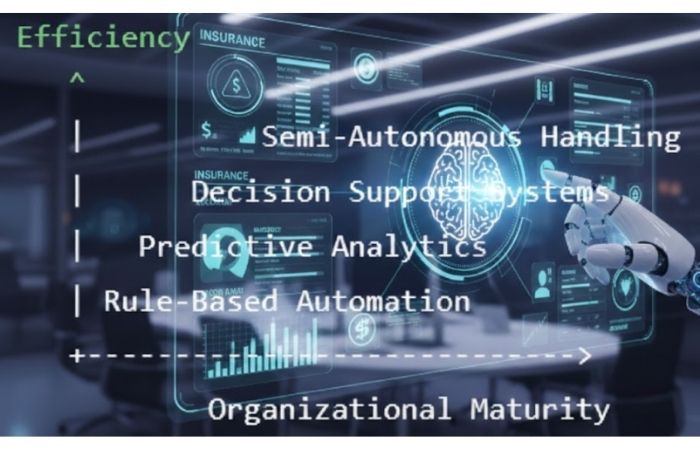
Level 1: Workflow automation.
Level 2: Predictive scoring.
Level 3: Decision augmentation.
Level 4: Low-severity autonomous claims.
Globally, many carriers remain between Levels 1 and 2.
Implementation Reality Check
Technology vendors often emphasize model capability. Implementation tells a different story.
Common obstacles:
- Legacy core systems resist integration.
- Claims data lacks standardization.
- Adjusters distrust automated scoring.
- ROI is poorly defined at the outset.
- Vendor lock-in reduces flexibility.
Transformation stalls when AI overlays old processes instead of redesigning them.
AI magnifies both efficiency and inefficiency. It does not discriminate.
Who Should Care Most?
AI-driven claims transformation is most impactful for:
- High-volume personal lines insurers.
- Large carriers with historical data depth.
- Third-party administrators seeking scale efficiency.
It is more challenging for:
- Small insurers with sparse datasets.
- Organizations lacking governance maturity.
- Markets with emerging AI regulatory frameworks.
Geographic nuance matters. The EU’s AI regulatory posture is more formalized than many other regions, influencing explainability standards.
Where This Is Heading
Generative AI is entering the claims environment:
- Automated claim summaries.
- Draft correspondence.
- Policy explanation assistants.
- Real-time internal knowledge retrieval.
These tools reduce cognitive load for adjusters.
But fully autonomous claims handling? Limited to low-risk scenarios for now.
The future is hybrid. Human-guided. System-accelerated.
Final Perspective
AI is transforming claims management by restructuring how decisions move through the workflow — not by eliminating the need for human judgment.
The most successful implementations:
- Target specific bottlenecks.
- Tie deployment to measurable KPIs.
- Invest in governance and monitoring.
- Redesign workflows alongside technology.
The least successful:
- Chase automation headlines.
- Ignore data quality.
- Underestimate regulatory complexity.
AI does not fix broken claims processes.
It exposes them.
And when implemented thoughtfully, it sharpens them.
