

Introduction
In the digital age, the terms “e-commerce” and “e-business” are often used interchangeably, but they represent distinct concepts. While both involve the internet and digital technologies, their scope, objectives, and functions differ significantly.
Understanding this distinction is crucial for entrepreneurs, business students, and professionals looking to establish or manage a digital presence. E-commerce refers specifically to the buying and selling of goods or services online. E-business, on the other hand, is a broader term that encompasses not only online transactions but also the entire digital transformation of business processes, including customer relationship management, supply chain management, internal communication, and online collaboration.
This guide breaks down the differences, key features, models, and real-world examples to provide a clear understanding of both concepts.
Difference Between E-Business and E-Commerce?
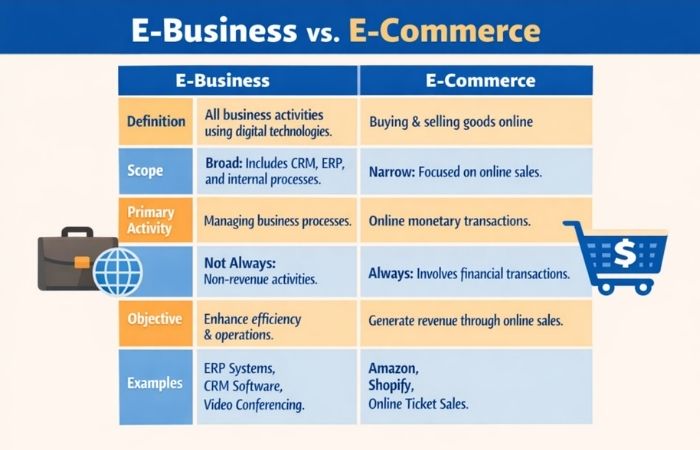
The core difference lies in scope and functionality. E-commerce is a subset of e-business. While e-commerce focuses solely on monetary transactions conducted over the internet, e-business covers all aspects of running a business using digital technologies.
| Aspect | E-Business | E-Commerce |
|---|---|---|
| Definition | The use of digital technologies and the internet to conduct all business activities, including internal processes, communication, and transactions. | The process of buying and selling goods or services over the internet, involving monetary transactions. |
| Scope | Broader. Includes e-commerce plus internal business functions like CRM, ERP, supply chain management, and digital collaboration. | Narrower. A subset of e-business focused specifically on commercial transactions. |
| Primary Activity | Managing business processes digitally—both front-end and back-end operations. | Facilitating online transactions—order placement, payment, and delivery. |
| Monetary Exchange | Not necessarily. Includes non-revenue activities like internal communications, employee portals, and digital inventory management. | Always involves a monetary transaction or financial exchange. |
| Objective | Improve overall business efficiency, reduce costs, enhance communication, and optimize processes using digital tools. | Generate revenue by reaching customers online, offering convenience, and facilitating sales. |
| Examples | Online employee training portals, internal ERP systems, video conferencing for team meetings, digital supply chain management, CRM software. | Amazon product sales, Shopify stores, online ticket booking, food delivery apps (the transaction itself), digital downloads. |
What is E-Business?
E-business (Electronic Business) refers to the integration of digital technologies, internet platforms, and information systems into all aspects of a business. It is not limited to selling products online; instead, it covers how a company uses technology to streamline operations, communicate internally and externally, manage resources, and serve customers.
In essence, e-business transforms traditional business models by leveraging the internet for activities such as:
- Internal communication (intranets, video conferencing)
- Customer relationship management (CRM software)
- Enterprise resource planning (ERP systems)
- Supply chain management (digital logistics and procurement)
- Online collaboration with partners and vendors
Key Features of E-Business
- Comprehensive Digital Integration: E-business involves the use of digital technology across the entire organization, including sales, marketing, human resources, finance, and operations.
- Internal and External Focus: It encompasses both internal processes (employee portals, inventory systems) and external interactions (supplier portals, customer service platforms).
- Process Optimization: The goal is to automate and optimize business processes to reduce costs, improve efficiency, and enhance decision-making through data analytics.
- No Mandatory Transactions: E-business can exist without direct online sales. For example, a manufacturing company may use an ERP system to manage inventory and procurement without ever selling a product on its website.
- Connectivity and Collaboration: It enables seamless collaboration between departments, partners, and stakeholders through cloud-based platforms, intranets, and communication tools.
- Scalability: Digital infrastructure allows businesses to scale operations, add new services, and expand into new markets without proportional increases in physical infrastructure.
What is E-Commerce?
E-commerce (Electronic Commerce) refers specifically to the buying and selling of products, services, or information over the internet. It involves the complete transaction cycle: product discovery, order placement, payment processing, and delivery (physical or digital).
E-commerce focuses on the customer-facing side of digital business. It enables businesses to reach a global audience, operate 24/7, and offer personalized shopping experiences. Common examples include online retail stores, digital marketplaces, subscription services, and mobile commerce apps.
Key Features of E-Commerce
- Monetary Transactions: Every e-commerce activity involves a financial exchange, whether it’s a one-time purchase, subscription, or digital payment.
- Online Storefront: E-commerce relies on a digital platform (website, app, marketplace) where products or services are displayed, described, and made available for purchase.
- Payment Gateway Integration: Secure payment systems (credit cards, digital wallets, UPI, net banking) are essential for processing transactions.
- Logistics and Fulfillment: For physical goods, e-commerce includes order processing, shipping, tracking, and returns management.
- Customer-Centric Interface: User experience (UX), product reviews, recommendations, and customer support are critical components.
- Global Reach: E-commerce allows businesses to sell beyond geographical boundaries without the need for physical stores in each location.
E-Business Models
E-business models describe how a company uses digital technologies to create value, generate revenue, and structure its operations. These models often incorporate e-commerce as a component but extend to broader business functions.
| Model | Description | Examples |
|---|---|---|
| B2B (Business-to-Business) | Digital business activities between companies. Includes procurement, supply chain management, and online wholesale transactions. | Alibaba (wholesale), Salesforce (CRM for businesses), Oracle ERP |
| B2C (Business-to-Consumer) | Businesses using digital platforms to interact with individual consumers. Includes e-commerce sales, digital marketing, and customer service portals. | Amazon (retail), Netflix (subscription), Nike (direct-to-consumer app) |
| C2C (Consumer-to-Consumer) | Digital platforms enabling consumers to transact or interact with other consumers. Often involves marketplaces or peer-to-peer systems. | eBay, OLX, Etsy, Airbnb |
| C2B (Consumer-to-Business) | Individuals offer products, services, or data to businesses through digital platforms. | Freelancing platforms (Upwork, Fiverr), influencer marketing, stock photography sites |
| Intra-Business | Digital systems used within a single organization to streamline internal operations, communication, and resource management. | Employee intranet, internal ERP systems, company collaboration tools (Slack, Microsoft Teams) |
| B2G (Business-to-Government) | Digital interactions between businesses and government entities, such as procurement, licensing, and compliance reporting. | Government e-tendering portals, tax filing platforms |
E-Commerce Websites

E-commerce websites are the digital storefronts where actual buying and selling occur. They vary based on business model, target audience, and functionality.
| Type | Description | Examples |
|---|---|---|
| Retail Websites | Direct-to-consumer (D2C) or multi-brand online stores where customers browse, select, and purchase products. | Amazon, Walmart, Flipkart, Myntra |
| Brand-Owned Websites | Single-brand websites where manufacturers sell directly to customers, bypassing intermediaries. | Apple.com, Nike.com, Samsung Shop |
| Marketplaces | Platforms that host multiple third-party sellers, offering a wide range of products under one interface. | eBay, Etsy, Aliexpress, Mercado Libre |
| Subscription-Based Sites | Recurring revenue model where customers pay periodically for access to products, services, or content. | Dollar Shave Club, Birchbox, Netflix, Spotify |
| Digital Product Stores | Websites specializing in downloadable or intangible goods such as software, e-books, music, or courses. | Adobe Creative Cloud, Gumroad, Udemy, iTunes |
| Service-Based Websites | Platforms where services (rather than physical goods) are booked, scheduled, or purchased online. | Uber, Urban Company, TaskRabbit, Upwork |
| Social Commerce | E-commerce integrated within social media platforms, allowing users to purchase without leaving the app. | Instagram Shops, Facebook Marketplace, TikTok Shop |
Conclusion
While e-commerce and e-business are closely related, they are not the same. E-commerce is a subset of e-business, focused exclusively on online transactions—the buying and selling of goods and services over the internet. E-business, however, is a broader concept that encompasses all digital business activities, including internal operations, supply chain management, customer relationships, and collaboration tools.
For businesses today, understanding this distinction is vital. A company may have a robust e-commerce platform but lack an integrated e-business strategy, leading to inefficiencies in inventory, customer service, or internal coordination. Conversely, a successful e-business strategy leverages digital technology to optimize every aspect of operations, with e-commerce serving as one component of a larger digital ecosystem.
As digital transformation accelerates, the line between the two continues to blur. However, recognizing their unique scopes helps organizations build more comprehensive, efficient, and scalable digital strategies.
FAQs
1. Is e-commerce part of e-business?
Yes. E-commerce is a subset of e-business. While e-business includes all digital business activities, e-commerce focuses specifically on online buying and selling.
2. Can a business have e-business without e-commerce?
Absolutely. A company can use digital tools for internal operations, supply chain management, and employee communication (e-business) without ever selling products online. For example, a manufacturing firm using an ERP system but selling through physical retail stores.
3. Which is broader: e-business or e-commerce?
E-business is broader. It encompasses e-commerce as well as all other digital business processes, such as customer relationship management, internal communication, and digital collaboration.
4. What is an example of e-business that is not e-commerce?
An employee intranet portal, a company using Slack for internal communication, or a business implementing an ERP system like SAP to manage inventory and procurement—none of these involve direct online sales, yet they are core e-business activities.
5. Do I need both e-commerce and e-business to run a successful online store?
Yes. To run a successful online store, you need e-commerce (the website, payment gateway, and sales process) and e-business (inventory management systems, customer service platforms, digital marketing tools, and internal coordination systems) working together seamlessly.
6. Is Amazon an e-commerce or e-business?
Amazon is both. It is a leading e-commerce platform for online retail, but it also engages in extensive e-business activities, including cloud computing (AWS), internal logistics optimization, digital advertising platforms, and partner management systems.
