

Introduction
Drone photography has revolutionized the way we capture images and video, shifting from a niche hobby to a critical tool across industries like real estate, filmmaking, agriculture, and infrastructure inspection. A drone, or Unmanned Aerial Vehicle (UAV), provides a unique bird’s-eye perspective that was once only possible with expensive helicopter rentals.
The regulatory landscape, costs, and career opportunities for drone photography vary significantly across the globe. This guide breaks down the key aspects for three major markets: India, the United States, and the United Kingdom. Whether you are a beginner looking to start a side hustle or a professional aiming to expand your services, understanding these regional differences is crucial for success.
Drone Photography Course
Gaining the proper certification is the first legal step to becoming a commercial drone photographer. Each country has its own aviation authority and licensing structure.
| Aspect | India (DGCA) | USA (FAA) | UK (CAA) |
|---|---|---|---|
| Regulatory Body | Directorate General of Civil Aviation (DGCA) | Federal Aviation Administration (FAA) | Civil Aviation Authority (CAA) |
| Required License | Remote Pilot Certificate | Part 107 Remote Pilot Certificate | GVC (General Visual Line of Sight Certificate) + Operational Authorization (or A2 CofC for open category) |
| Course Focus | DGCA exams, air navigation maps, drone rules, flight safety, radio telephony. | Aeronautical knowledge, weather, loading, crew resource management, FAA regulations. | Theory (GVC), practical flight assessment, air law, meteorology, flight performance. |
| Typical Duration | 5-10 days of ground school + exam slot | Self-study (approx. 15-20 hours) + exam | 1-2 weeks of online theory + 1 day practical assessment |
| Average Cost | ₹15,000 – ₹35,000 (including training) | $150 – $300 (exam fee only) | £300 – £1,200 (depending on training provider) |
| Key Restriction | No “Beyond Visual Line of Sight” (BVLOS) without special permission. Strict “No Fly Zones” near borders and strategic locations. | Must keep drone in visual line-of-sight (VLOS). Night operations permitted with anti-collision lights post-2021. | VLOS mandatory. Geo-zones (Flight Restriction Zones) are strictly enforced via apps like Drone Assist. |
Drone Photography Jobs
The demand for certified drone pilots is growing across all three countries, though the sectors driving this demand vary.
| Sector | India | USA | UK |
|---|---|---|---|
| Real Estate & Architecture | High demand for luxury villas, farmhouses, and gated communities in metro cities. | Extremely saturated but steady. High demand for 3D modeling and virtual tours. | Consistent demand for historic building surveys and high-end property marketing. |
| Infrastructure & Surveying | Rapid growth due to government projects (Smart Cities, highways, power lines). High need for DGCA-certified pilots for compliance. | Largest sector. Energy, construction, and telecom giants hire regularly. | Strong sector due to renewable energy (wind farms), rail, and construction inspections. |
| Film & Media | Booming film industry (Bollywood/Regional). Requires strict clearances, but rates are high. | Hollywood and content creation. High competition but lucrative for skilled cinematographers. | BBC, Sky, and independent film productions. Requires strict CAA permissions for urban shoots. |
| Agriculture | Emerging market. Government subsidies for drones in farming (spraying/surveying) are increasing. | Mature market. Large-scale farms use drones for crop health monitoring. | Niche but growing for precision farming and environmental research. |
| Wedding Photography | Massive market. “Drone shots” are now a standard expectation for mid-to-high budget weddings. | Popular for outdoor weddings. Often bundled with traditional photography packages. | Popular for countryside weddings. Requires landowner permission in addition to CAA rules. |
Drone Photography Salaries
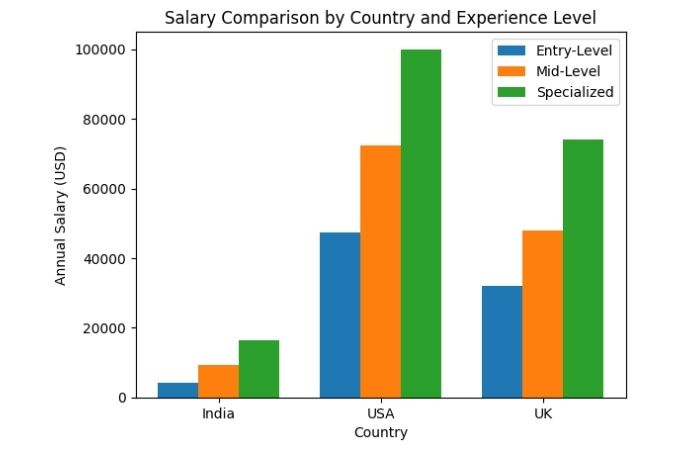
Earnings vary widely based on experience, specialization, and the type of employment (freelance vs. full-time).
| Aspect | India | USA | UK |
|---|---|---|---|
| Entry-Level (0-2 yrs) | ₹20,000 – ₹40,000 per month (or ₹1,500 – ₹5,000 per project) | $40,000 – $55,000 per year (or $50 – $100 per hour) | £22,000 – £28,000 per year (or £150 – £300 per day) |
| Mid-Level (3-5 yrs) | ₹50,000 – ₹80,000 per month (or ₹8,000 – ₹20,000 per project) | $60,000 – $85,000 per year (or $100 – $200 per hour) | £30,000 – £45,000 per year (or £400 – £600 per day) |
| Specialized (Surveying/Mapping) | ₹80,000 – ₹1,50,000+ per month (project-based can be higher) | $80,000 – $120,000+ per year (high demand for LiDAR and thermal experts) | £45,000 – £70,000+ per year (strong in energy and construction sectors) |
| Freelance Day Rate (Avg) | ₹5,000 – ₹15,000 per day | $500 – $1,500 per day (depending on equipment/editing) | £400 – £800 per day (plus travel expenses) |
Drone Photography Costs
The cost to enter the industry includes hardware, software, and legal compliance.
| Cost Category | India | USA | UK |
|---|---|---|---|
| Entry-Level Drone (e.g., DJI Mini 4 Pro) | ₹80,000 – ₹1,00,000 | $750 – $1,100 | £700 – £1,000 |
| Professional Drone (e.g., DJI Mavic 3 Pro / Inspire) | ₹2,20,000 – ₹4,50,000+ | $3,000 – $10,000+ | £3,000 – £9,000+ |
| Licensing & Training | ₹15,000 – ₹40,000 | $150 (exam) – $1,500 (training) | £300 – £1,200 (GVC/A2 CofC) |
| Insurance (Annual) | ₹10,000 – ₹30,000 (mandatory for commercial ops) | $500 – $1,500 (depending on liability coverage) | £300 – £800 (mandatory for commercial operations; public liability) |
| Maintenance & Batteries | ₹20,000 – ₹50,000 per year | $500 – $2,000 per year | £400 – £1,500 per year |
| Software (Mapping/Editing) | ₹5,000 – ₹20,000/month (DroneDeploy, Adobe CC) | $50 – $300/month | £40 – £250/month |
Drone Photography for Beginners
Starting requires a mix of legal compliance and practical skill. Here is a beginner’s checklist for each country.
| Step | India | USA | UK |
|---|---|---|---|
| 1. Understand the Law | Register your drone on the DigitalSky platform. Nano drones (<250g) are less regulated, but commercial use still requires protocol. | Register your drone with the FAA if it weighs over 0.55 lbs (250g). Display your registration number on the drone. | Register your drone with the CAA if it has a camera (which most do). Display your Operator ID. |
| 2. Get Certified | Pass the DGCA exam at an authorized center. You cannot fly commercially without this. | Pass the FAA Part 107 exam at an authorized testing center. Recreational flyers must take the TRUST test. | Obtain A2 CofC for sub-2kg drones in built-up areas, or GVC for full commercial freedom. |
| 3. Buy the Right Gear | Start with a DJI Mini series (sub-250g) to avoid some airspace restrictions, but check DGCA rules for the “nano” category. | Start with a DJI Mini 4 Pro or DJI Air 3. The sub-250g category is exempt from some registration rules. | Sub-250g drones (like DJI Mini) offer the most flexibility under the Open Category, allowing flights near people with A2 CofC. |
| 4. Practice | Practice in open, uncrowded areas away from military bases, airports, and international borders. Use the DigiSky app for no-fly zones. | Use apps like B4UFLY or AirMap to check airspace. Practice in Class G (uncontrolled) airspace. | Use the Drone Assist app by NATS to check flight restriction zones. Always ask landowner permission before takeoff. |
| 5. Secure First Jobs | Network with local real estate agents and wedding planners. Offer portfolio shots for free to build a DGCA-compliant portfolio. | Join local real estate investor groups. Offer 3D mapping services to construction companies. | Focus on rural properties, farms, and heritage sites where landowner permission is easier to obtain than complex urban CAA authorizations. |
Best Drones for Wedding Photography

Wedding photography requires portability, silent rotors, and excellent low-light performance for evening receptions.
| Drone Model | Key Features | Suitability | India Price (INR) | USA Price (USD) | UK Price (GBP) |
|---|---|---|---|---|---|
| DJI Mavic 3 Pro | Triple-camera system (4/3 CMOS, 70mm mid-tele, 166mm tele), omnidirectional obstacle sensing. | Best Overall. Professional quality for bridal entries and venue shots. Excellent low-light. | ₹2,20,000 | $3,000 | £2,700 |
| DJI Air 3 | Dual cameras (wide-angle & 3x mid-tele), 46-min flight time, 20km transmission. | Best Value. Compact, powerful, perfect for outdoor ceremonies and tight schedules. | ₹1,40,000 | $1,600 | £1,400 |
| DJI Mini 4 Pro | Sub-250g, 4K/60fps HDR, omnidirectional obstacle sensing, vertical shooting. | Best for Portability & Compliance. Ideal for venues with strict noise/safety rules. Excellent for social media reels. | ₹95,000 | $1,100 | £900 |
| Autel EVO Lite+ | 1-inch CMOS, adjustable aperture, 6K video, strong low-light performance. | Alternative to DJI. Good color science for skin tones. Less restrictive geofencing. | ₹1,30,000 | $1,500 | £1,350 |
Best Brands of Drones and Prices
The drone market is dominated by a few key players, with DJI holding the largest market share globally.
| Brand | Reputation | Popular Models | India Price Range (INR) | USA Price Range (USD) | UK Price Range (GBP) |
|---|---|---|---|---|---|
| DJI | Market Leader. Best-in-class technology, obstacle sensing, camera quality, and software ecosystem. | Mini Series, Air Series, Mavic Series, Inspire Series | ₹35,000 – ₹8,00,000 | $350 – $12,000 | £300 – £10,000 |
| Autel Robotics | Primary DJI Rival. Known for rugged build, superior thermal cameras (EVO II Dual), and no mandatory geofencing. | EVO Lite+, EVO II Pro, EVO Max | ₹80,000 – ₹3,50,000 | $1,000 – $6,000 | £900 – £5,000 |
| Skydio | Autonomy Leader. Unmatched obstacle avoidance and autonomous flight capabilities. Primarily used for inspection and public safety. | Skydio 2+, Skydio X10 | Not widely available; import only | $1,200 – $10,000+ | Import only; limited availability |
| Parrot | European Brand. Focused on professional mapping and agriculture (Parrot ANAFI series). Lightweight and portable. | ANAFI Ai, ANAFI USA | ₹70,000 – ₹2,50,000 | $800 – $7,000 | £700 – £6,000 |
Conclusion
Drone photography is a dynamic and rewarding field, but success hinges on navigating the distinct regulatory frameworks of your country.
- In India, the market is rapidly expanding, driven by infrastructure and weddings, but requires strict adherence to DGCA licensing and the DigitalSky platform. The cost of entry is moderate, but the bureaucratic process is the biggest hurdle.
- In the USA, the market is mature and highly competitive. The FAA’s Part 107 is a standardized, accessible exam. Specializing in niches like LiDAR, thermal imaging, or 3D mapping is the key to high earnings.
- In the UK, the CAA’s risk-based Open and Specific categories offer flexibility, especially for sub-250g drones. Landowner permission is as critical as CAA authorization. The market values high-quality surveying and creative cinematography for heritage and rural properties.
Regardless of location, the future of drone photography lies in automation, artificial intelligence for flight paths, and integration with software for data analysis. For aspiring pilots, investing in high-quality training, reliable equipment, and proper insurance is the foundation for a sustainable career.
FAQs
1. Do I need a license to fly a drone for fun (recreationally)?</3>
- India: Yes, even for recreational use, you must register on the DigitalSky portal and follow guidelines. Nano drones (<250g) have fewer restrictions but are not entirely unregulated.
- USA: No license is required for recreation, but you must pass the free online TRUST test and carry the certificate.
- UK: No license for recreational flying, but you must register as an Operator and pass the online Flyer ID test.
2. Can I fly a drone over a wedding venue without permission?
- No. In all three countries, you must have explicit permission from the landowner (venue). Additionally, you must not fly over people not involved in the operation unless you have the appropriate license and drone category (e.g., CAA A2 CofC in UK, Part 107 waiver in USA, or specific DGCA permissions in India).
3. What happens if I fly in a “No-Fly Zone”?
- Penalties are severe. In India, you can face fines up to ₹1 lakh and imprisonment under the Aircraft Act. In the USA, the FAA can issue fines up to $30,000 per violation. In the UK, the CAA can impose unlimited fines or imprisonment. Apps like DigiSky (IN), B4UFLY (US), and Drone Assist (UK) help you avoid these zones.
4. Is drone photography profitable?
- Yes, but profitability depends on specialization. General photography is saturated; however, niche areas like industrial inspection, 3D mapping for construction, and high-end wedding cinematography offer significant returns. In the US and UK, experienced survey pilots can earn over $80,000/£60,000 annually. In India, top-tier commercial pilots earn ₹80,000+ monthly.
5. Which is the best drone for beginners?
- DJI Mini 4 Pro is universally recommended. Its sub-250g weight simplifies regulations in many cases, yet it offers professional-grade camera features and obstacle sensing, making it safe and legal for beginners to learn on.
